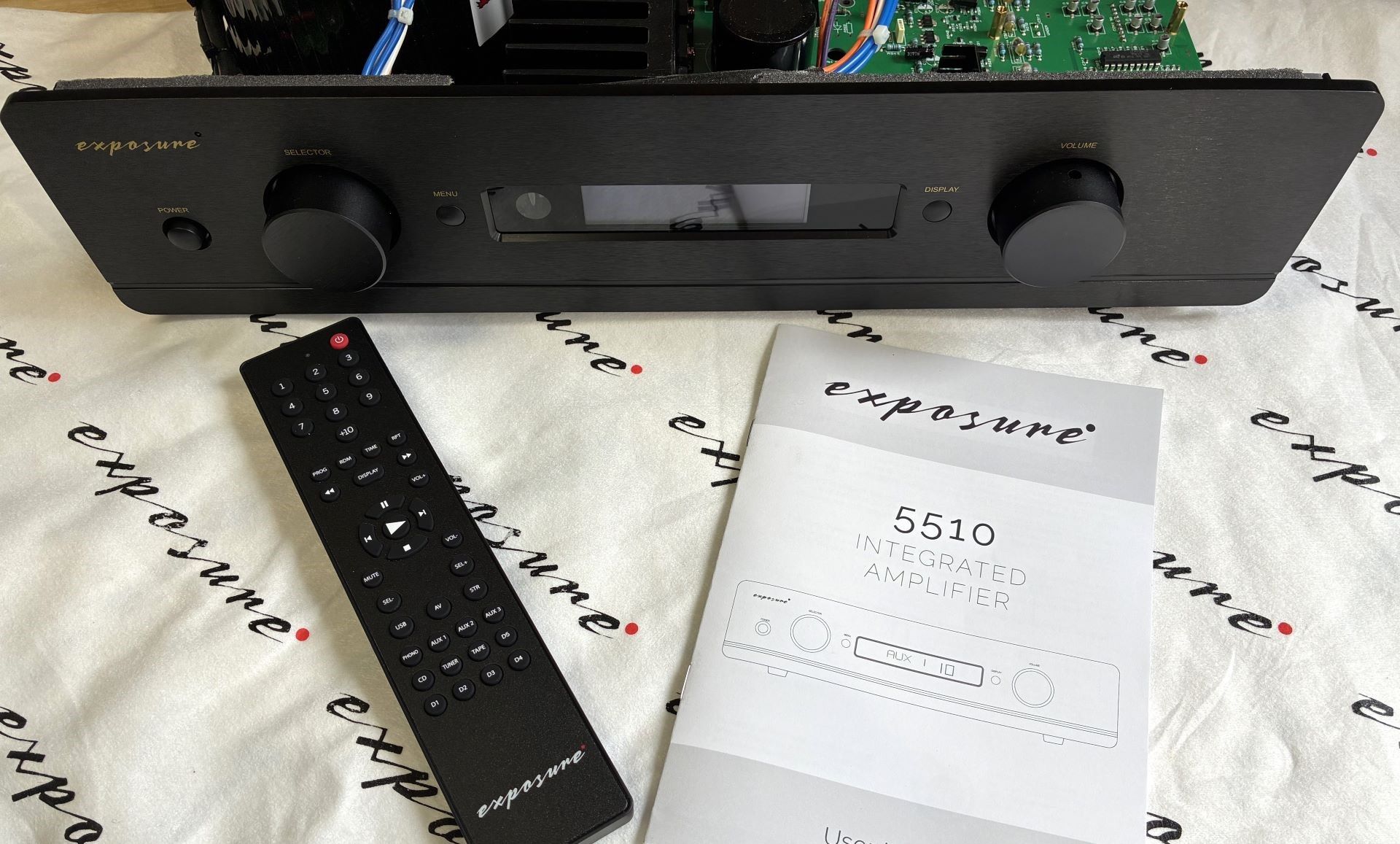
Designer of Exposure HiFi, Tony Brady, adds insights to the Exposure 5510 expert review. Comparisons with the 3510, the sound profile, some Exposure history and revealing new, yet to be released projects. Our host lends his expertise to a review of the build quality inside and out, functionality and most importantly – sound. Better than Accuphase? Definitely better than Naim.
LISTEN NOW on Not an Audiophile the Podcast – Full Review on Not An Audiophile.com or on all good podcast platforms.
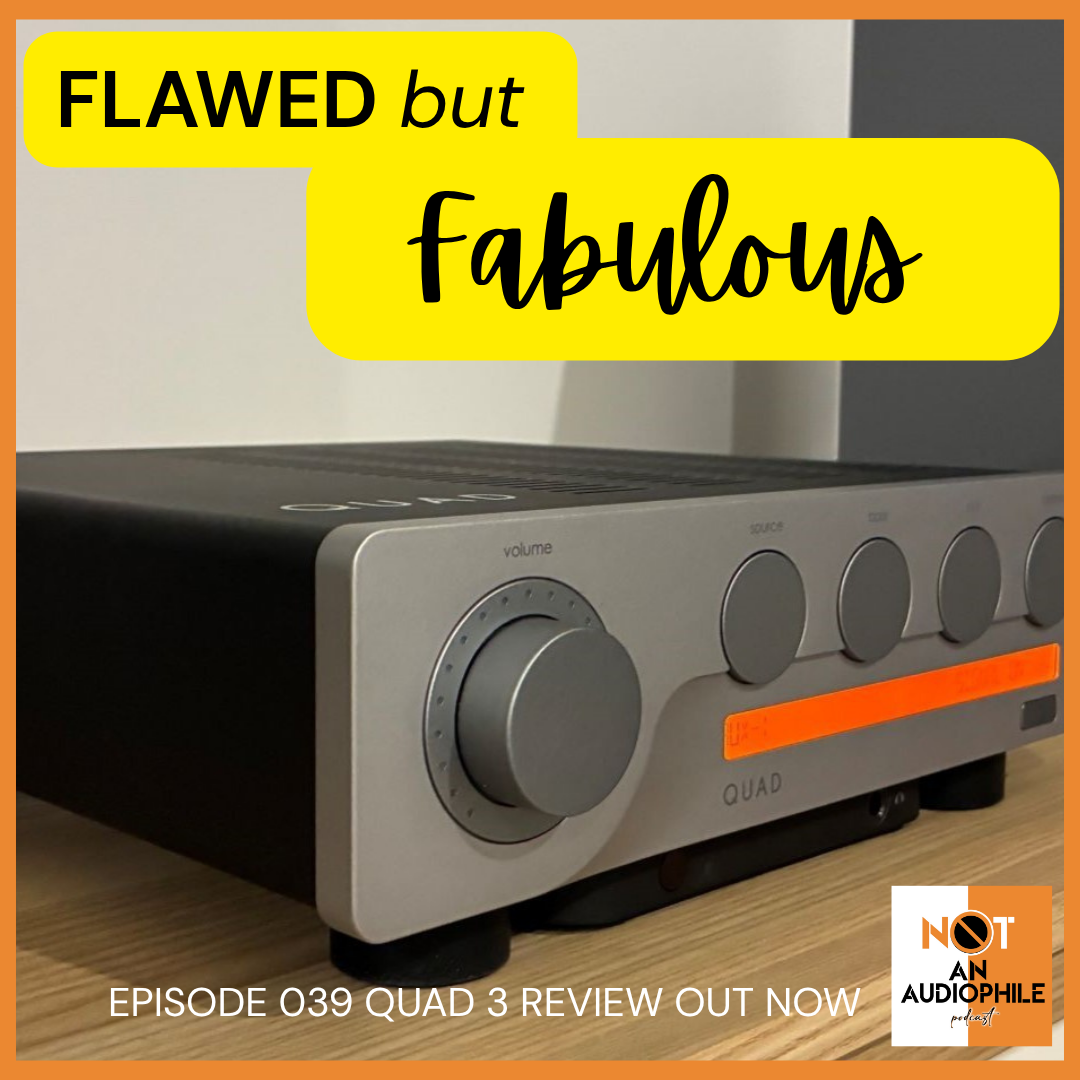
A Quad 3 amplifier review with a difference. Performance, usability, aesthetics and sound are important but our tech goes inside for a look at the electronics.
LISTEN NOW on Not an Audiophile the Podcast – Full Review on Not An Audiophile.com or on all good podcast platforms.
Inside the Quad 3 Integrated Amp with Not An AudiophileInside the Quad 3 Integrated Amp with Not An Audiophile
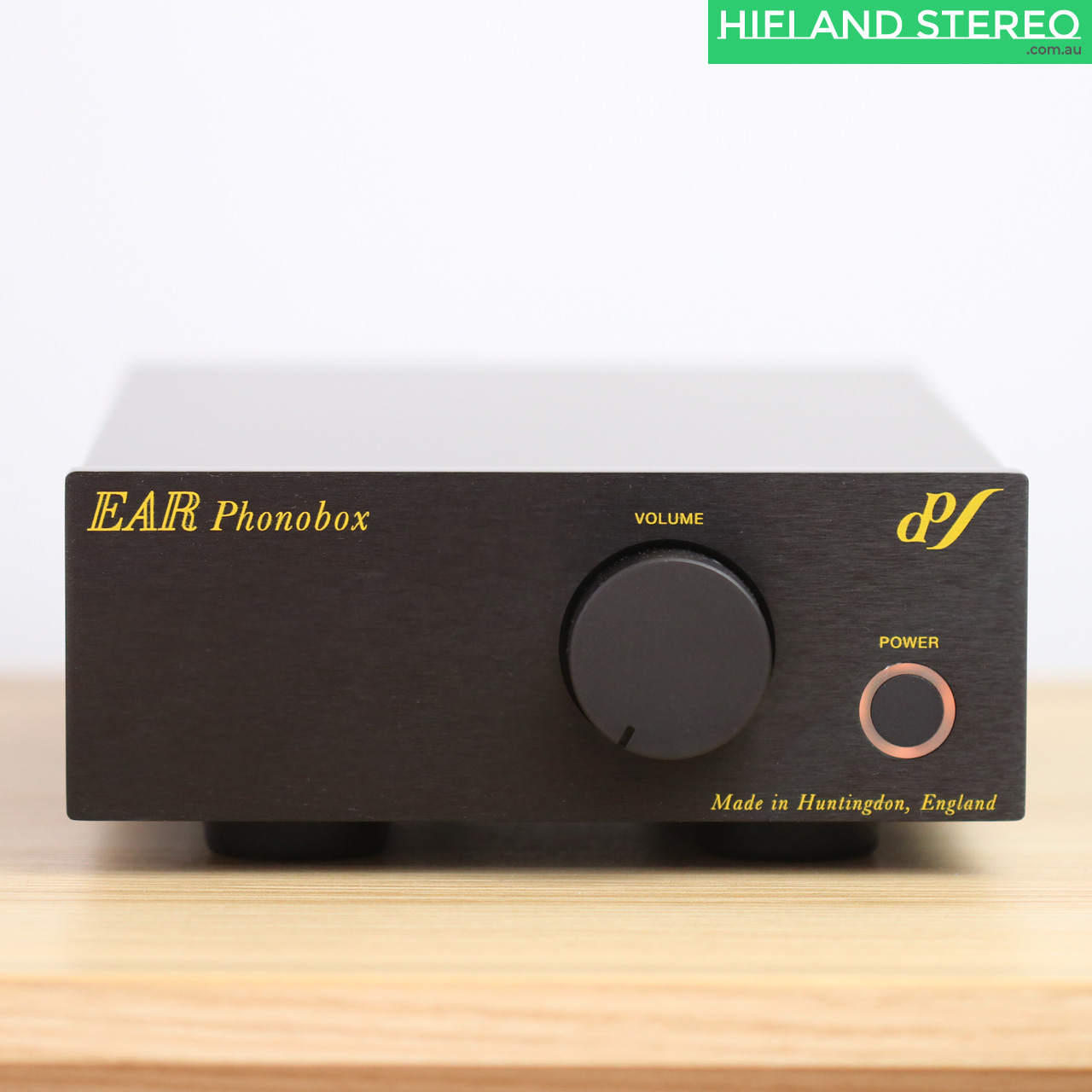
Let me just quickly get the correct title of this tube phono pre-amplifier out of the way. The name appears in various forms on the internet so I thought a quick check with HQ would be the answer. Strangely the product under review here does not appear on the EAR Yoshino website. I remembered I had a ‘snap’ of the EAR Phonobox at it’s release at Munich High End 2019. I then also remembered I had the instruction manual sitting on the desk beside me and the actual product in the listening room… Combining all of these data sources I guess we can be sure that indeed it is the ‘EAR Phonobox’, not the Phono Box, PhonoBox or any other variation of the basic concept of a box that amplifies a phono signal.
EAR Yoshino Phonobox on display at it’s release – Munich High End 2019
Of course the lack of updates on the EAR Yoshino website may well be due to being distracted by the sad passing of the creator of the company, Tim de Paravicini. Designer of this very product and possibly, the last product designed by Tim. In some ways the Phonobox is not a bad note to end on. It enjoys simple, straight to the point engineering and industrial design. It employs the minimum necessary components to perform the function required and these are incased in a ‘box’ just big enough for the job. The sound seemingly extracts the best tubes have to offer, whilst minimising the negatives that can come from using devices designed 100 years ago.
13D16 tubes in EAR Yoshino Phonobox Side View
Even the normally complex, input-matching arrangements for a Moving Coil cartridge are forsaken. In this case, they are not required to the same degree as traditional active designs. The Phonobox uses matching transformers to obtain the increase in level required when using a very low output MC cartridge. Other aspects of the design, which have Tim’s signature style written all over them include; the choice of valve; the lack of fancy ‘audiophile’ brand components and for a small extra fee, a chrome front panel. In regard to the vacuum tube choice, the 13D16 (three of them) is not a tube ID that Googles successfully. It is, in effect, an ECC83 with a few tweaks and is made specifically for EAR Yoshino. Tim made it clear to myself (and anyone who would listen) that mucking around trying various different versions of a tube in one of his designs was not on. The amplifier has been designed to work with this tube and anything else will throw it out of whack (I’m paraphrasing, he would have said it somewhat more elegantly, and firmly). I guess using your own tube specification stymies the less adventurous ‘tube-rollers’. So all in all a very typical Tim de Paravicini design. Slightly quirky tube choice, coupled with a simple internal design and solid, last-forever construction.
EAR Yoshino Phonobox Rear View
The simplicity continues on the outside with just an output level control, power switch, a pair of inputs and a switch to choose between MM or MC. The apparent quality is high but certainly not some kind of hewn-from-solid swiss watch type of contraption. Just simple good quality construction that should last the better part of a lifetime. The volume control is the familiar and high quality, Alps Blue Velvet. The front panel is a solid hunk of metal, as is the volume knob. The switches and sockets are a notch or two up from basic spec. The substantial rubber feet will never fall off as they are firmly screwed on, and the casework is of decent thickness folded steel. The earth screw is easy to use and again, not the crappiest thing they could find in the parts bin. The more I look at this outwardly simple device the more I realise the amount of thought that has gone into it. I also note that many of these rather good quality parts are not often part of the spec of similarly priced phono stages.
EAR Yoshino Phonobox Bottom Panel
This new phono pre-amp from Mr de Paravicini is of course not his first effort at a turntable signal amplifier. The 834 that went before came in a fancier box (more gold plated parts), and was of slightly more imposing proportions. The 834 sold for approximately $1000 more than the Phonobox. It had been around for 25 years give or take and had been improved along the way. It is a fine sounding pre amp and sold very well over the years. My guess is though, that it would have sold even better at the price point the Phonobox is now offered at. Anyway, at some point the design has been reverse-engineered or has escaped the walls of EAR Yoshino HQ. As a result, Tim felt a complete re think was in order. He did not disguise well his annoyance at the dodgy rip off versions of his early design being sold on eBay cheaply. A clean sheet of paper design was in order and here we are today listening to his completely revised version of his company’s entry level phono stage.
EAR Yoshino Phonobox Front View
The sound!
I initially tried the VM530 MM cart already screwed to my older LP12 on the MM setting (of course) and sat back, enjoying the pleasantly detailed and snappy performance. Valve stodge or an uneven, coloured response was not apparent at all. In fact the sound was rich and clean without the slowness or lack of excitement that sometimes comes from tube amplifiers. Maybe not so much from low level phono pre-amps but nonetheless, I feel this ‘zip’ was not a feature of the EAR 834P. Memory tells me it was a smidge tailed-off in the top and for me a small notch too ‘warm’. The Phonobox is an altogether more interesting listen, to the degree that those who have doubted the value of tubes in a low level circuit like this should re-visit the possibilities.
I had a new Audio Technica OC9XEN on hand (which will be reviewed shortly) so I set about fitting it to the the Sondek and getting a taste of the Phonobox with the transformers ‘in-circuit’. My memory of the less expensive Audio Technicas with fixed magnets is of them offering a warmer balance than the more expensive versions. If this is the case then maybe the Phonobox in MC mode is the tinniest bit brighter than neutral but it won’t be much. Not that I am implying the frequency response is anything other than more or less dead flat (ignoring RIAA de emphasis). It’s more the nature of the way these tubes and their accompanying circuit ‘sound’. This is one fast and detailed tube circuit, no doubt. Hence it could be described as being a bees antenna brighter than neutral. However it really is just the amount of detail and pace, and I wasn’t expecting it. The 834 was marginally the other way I reckon. The bass is amazing, real snap, weight and poise. The stereo performance was somewhat holographic, and a very stable hologram at that.
Back to back, MM versus MC, I don’t think there is anything in it. The basic character of the amplifier remains the same. I listened to a record that presents a real challenge, Kerrie Biddel, Live at Studios 301, recorded circa the ‘dark ages’. Through the Phonobox, her voice shines and yet ever so sweetly which rarely happens listening to this album. Her voice can have an edge to it but not with this combination. The sax and flute on this album are very well recorded but again can sound a touch grainy. Thanks to the EAR’s ‘just-right’ character, these instruments now sound perfect and Graham Jesse’s skills can be fully enjoyed.
I chose to lift the stylus from the groove at this point as it was time to test the beer for this review. Before I ‘cracked-tubes’ I listened again, this time to silence. For a moving coil pre-amp employing vacuum tubes as active devices this amp is incredibly quiet. With the Linn’s motor still running and both volume controls dialed to max there is only a muddled blend of microscopic hum and noise. At a later time with the VM530 Audio Technica cartridge refitted, I note (in Moving Magnet mode) this pre-amp to be virtually dead quiet. This is quite a win really as one of my key reasons not to get excited about some tube phono stages is noise. Problem solved!
On another note, a fantastic reason to use tubes in a phono stage I think, is to be in an analogue synergy with the source. Actually, it’s nothing to do with analogue as transistors of course still operate as analogue devices in a class A circuit. What it is though, is a nostalgic synergy. It somehow seems right that the old world of black vinyl replay should be coupled with what was used at the time when LPs began. The valve! I highly recommend taking a listen to this pre-amplifier if a superior phono stage is on your shopping list.
For – Elegant simple industrial design coupled with typical handcrafted UK build quality
For – Plug and Play MC connection, no messing with loading settings etc.
For – An almost perfectly neutral balance coupled with a good dose of valve friendliness, balanced by plenty of detail and pace
For – Fast accurate bass and there is plenty of it.
For – Very enjoyable and stable stereo imaging
For – Handy output level control allowing you to perhaps even use it as a single input pre-amplifier (with just a power amp).
For – Very good component quality throughout. This unit will last a long time.
Against – Lack of MC adjustments will trouble some.
Against – Not actually cheap, but when compared with other offerings at the price range it stands out as something quite different to marketing orientated, op amp stocked, mass produced boxes.
Against – Runs quite warm. For maximum life I suggest switching it off between listening sessions. It only takes 15 minutes warm-up to sound at it’s best.
Price – $2495
Dimensions – 180mm Wide x 79mm High x 312mm Deep inc volume knob and earth terminal.
Slipstream IPA is an enjoyable enough beer. It pours with a bit of not particularly dense head that in turn quickly dissipates. There is little nose if any when you crack the can, and not much at all from the glass as you sip it. Colour is lighter than most, malt flavour lighter than most. A somewhat nasty aftertaste follows. As I said, an enjoyable enough beer but this is not in the class of other IPAs I have recently tried. Alcohol is nicely disguised which might be part of why it slips down easily but not with the satisfaction of say Helios Cyclops or Sea Legs Breakaway IPA. Unfortunately it’s just another IPA made locally to an okay standard. Cool name, I wanted to like it, but sorry it’s a solid 6.8 out of 10 for me. Oh and writing “Bright, Fruity, Aromas with Herbal Undertones blah blah blah” or “Hints of Bubblegum, Fruit Blossoms and Apricot” on the can doesn’t make it so. Yeah I bought a four pack but I’m not buying another. Less BS on the outside of the can and more effort with the process of making what’s inside the can would be a good plan. Sorry about the negativity, but I have a couple of crackers coming up in future reviews, I promise!
At first glance it may seem that the new 2510 from Exposure is just a 2010 with a couple of features removed. The 2010 had an optional plug-in phono module arrangement for either MM or MC depending on your requirements. The 2510 has a ‘fixed’ inbuilt MM only phono stage with no upgradability. This could in fact seem like a downgrade from what went before. However, it isn’t as this new model from Exposure Electronics has been refined in a number of key areas. Judging by what I heard during this review there is definitely more to it than some phono input tweaks and the the swapping of a ‘0’ for a ‘5’ on the model number. Please read on…
Before I get to what I found inside, lets talk about the 2010 model further, and Exposure in general. For those not familiar with Exposure Electronics the brand, it has been around as long as Naim (established in 1974) but clearly is not as well known. Also like Naim, it’s based in the UK and still manufactures in its own facility. In Exposure’s case, the factory is on the south coast near Worthing. In fact, it is just one kilometre as the crow flies from the Bowers and Wilkins factory. Oh, and in a further ode to British high fidelity history, they are located on Chartwell Road. Where the two brands diverge is Naim is a household name (in at least music loving families) and Exposure is generally not. Except for the folk who are members of the cult-like Exposure Fan Club, which actually has more members than you might expect.
The 2510 effectively replaces the 2010, which has long been a a popular and affordable model in the Exposure range. The 2010 has been around for perhaps 20 years. It has provided an entry point to Exposure ownership for those looking for a step above run-of-the-mill. The 2010 generally sold for $2000 or less. The power output of the 2010 and the new 2510 are similar at around 75 watts per channel into 8 ohms. The 2010 has been both a Mosfet and Bipolar transistor output stage design. The 2510 retains the more recent bipolar discrete output design of the 2010.
Exposure Electronics 2510. Available in Black or Titanium as pictured here.
I’m not sure who’s responsible for this lack of fame and familiarity for Exposure, because it certainly isn’t the fault of the product. Having had some exposure to Exposure (groan…) over the years my experience has always been positive in regard to ease of operation, reliability, sound quality and listening enjoyment.
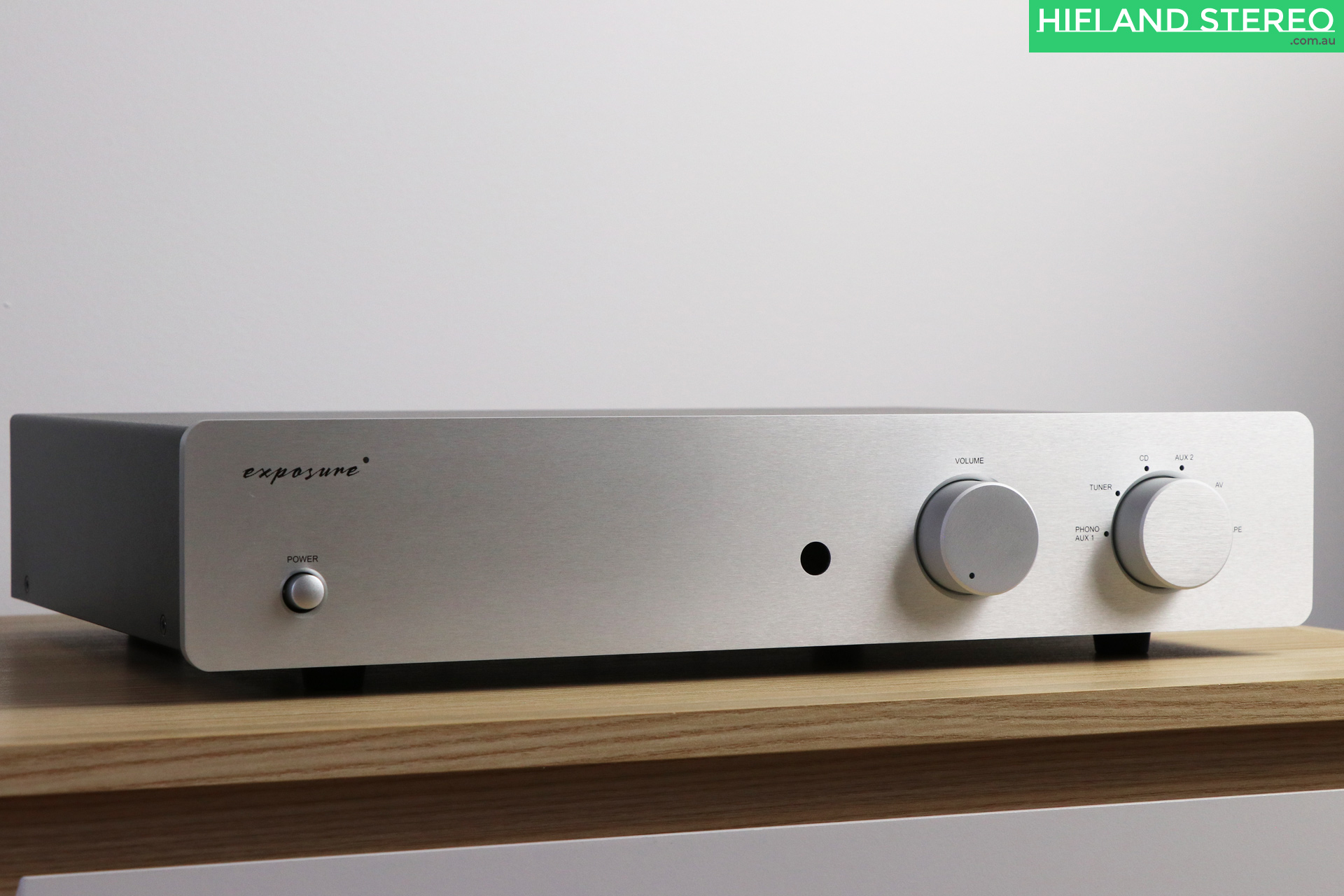
The feature list of the 2510 is super simple. The front panel sports a volume control, input selector and a power switch. This makes it more highly featured than the Naim Nait which hides it’s power switch ’round the back. For the sake of luxury or laziness it also comes with a remote control (with many more buttons than would appear to be required). It, of course, has the previously mentioned MM phono stage. It also offers an AV bypass function (effectively turning it into a power amp), a tape out and a pre-amp output. So in reality the Exposure 2510 has everything you might need for a good old style analogue stereo system.
Clunk on clunk off power switch makes sure there is absolutely no stand by trickle current raising your power bills.
Under the hood – It has a good quality case of simple folded aluminium sheet construction, with an aluminium lid, and a fat slab of aluminium as a front panel. The lid is not ventilated in any way as the amp runs particularly cool. Having removed the lid for a peak inside, I discovered a further slab of aluminium under the circuit board with the output transistors screwed down to it. Together this slab of aluminium and the aluminium casework act as an excellent heatsink. There is no need for external heatsinking or convective cooling. Full marks for this as dust and salt air are not good for any electronics and a fully enclosed case largely solves this problem.
My recollection of the last time I had the lid off a 2010 (fitting a phono stage) was that there were plenty of premium components inside. Having said that, the 2510 may have taken the premium parts list to a new level. The 2510 premium bill of materials includes: Elna electrolytic capacitors; a mains transformer of toroidal design; and main filtering caps of European manufacture in the form of Kendeils. Even the bipolar output stage employs very high current Toshiba devices. The volume level is controlled by an Alps Blue Velvet motorised pot. This impressive parts list is a great start in the quest for quality sound and is certainly likely to help with longevity. It is worth mentioning that having these kinds of quality components inside an amp at this price is unusual.
Elna Elna everywhere. They shouldn’t stop or blow their top.
A few other observations of the general design would include: (a) no obvious unnecessary over-engineering of the circuit (b) no speaker output relay (see tech notes in green below) (c) the speaker terminals are of the banana socket variety (d) input switching is via microprocessor controlled relays. Everything has a nice feel to it. Yes, it lacks visual ‘edge’. However I’m guessing money not spent on industrial designers and fancy casework has instead been spent inside. This no doubt helps with the real reason amplifiers exist – to make sweet music !
Banana sockets only for speaker connections. I suppose it forces some to fit connectors to their cables but others will be annoyed at no binding posts…
And the sound ! – My first thought whenever I listen to an Exposure product is just how damned neutral they generally are. This is definitely the case with the 2510, unlike some amps that have a definite ‘colour’. Initially it’s slightly disarming…it just does everything sort of really well. It’s annoying because as a reviewer you can’t grab any one aspect of performance and carry on about it. For instance, the overall sound is very clean, smooth, and obviously fully extended at both ends of the spectrum. There is little grit or grain, and maybe its even a smidge ‘sweet’. The old “straight wire with gain” comes to mind. Stereo-wise, it’s big and wide, there is plenty of detail and it’s very fast. Although, I reckon it takes a few minutes to adjust to this lack of colour. In the end, 20 minutes in and I’m loving it, playing all sorts of things and enjoying the music.
I played Yello’s ‘30,000 days’ which had a huge stage. The finest of subtleties were delicately handled AND with a pace not always heard. It’s exciting! There is a real finesse about the way this amplifier reproduces percussion. The 2510 avoids sounding thrashy and trashy and yet offers up what feels like all the detail in the recording. The bass is extended and may be just a touch ‘full’ but in balance with the way the rest of the spectrum is reproduced. I like it a lot!
The Exposure 2510 only contains what is required to amplify the signal. No unnecessary engineering fireworks going on here.
Calling up Jeff Becks ‘Live at Ronnie Scott’s’ and the track ‘Cause we’ve ended as lovers’ the bass solo (and what a solo) from Tal Wilkenfeld is wondrous. The Exposure allows us to hear more of what she is doing than many amplifiers. The 2510 also opens up this slightly closed-in sounding recording without a hint of hardness or undue sizzle.
I listened to dozens of tracks before realising I should actually note a few things down and scratch together this review. I guess that is the test and it passed. If you forget what you are doing and just start to listen to music – job done. I have heard plenty of products where I would just like to turn it off. Not so in this case.
The negatives? Well it’s not really a negative but it doesn’t punch extra hard in the lower octaves and it doesn’t have the apparent ‘grip’ of a huge amp or that Naim ‘snap’. It swaps that kind of grip for a reassuring warmth which is again in balance with the rest of the amplifier’s attributes. This attribute meshes nicely with its character in other areas.
No cutting of corners with component selection including mains toroidal transformer.
Amplifiers do all indeed sound slightly different. Their character varies for generally obvious reasons such as the output devices being of one type or another. Or perhaps the outright power or damping factor might offer more control over the movement of your speakers bass units etc. In this case, I think the Exposure sounds the way it sounds simply because it has the bare minimum of stuff in between the input and output sockets. Just enough ‘doins’ to make the waveform bigger and allow the loudspeakers to sink some current. That’s that. I don’t think there is much more to it. I love simple reliable things that are enjoyable to use, and very enjoyable to listen to. Hence I did rather like the 2010 that went before. I rather prefer this incantation though as it sounds a bit bigger and even more charming.
If you just want to plug in an outboard streamer, CD player or turntable, connect speakers and do some listening the 2510 is perfect. Bluetooth, an app to control it and a 5 inch display are not available options.
The 2510 is for those who value sound quality above a long feature list. If this is you, then you should definitely take a close look at this new integrated amplifier from Exposure Electronics. Very Highly Recommended! Happy listening!
Click on any image above and peruse the gallery for High Resolution images.
For – A genuinely good sounding amplifier. Incredibly transparent, clean and enjoyable to listen to.
For – First class build quality and components at the price.
For – Built in the UK if that is important to you.
For – Simple to use, and a couple of useful extras such as AV mode and pre amp outs. Not always available on this type of amp.
For – Sealed casework makes damage from salt air unlikely.
For – It runs cool and includes premium quality components inside making a long life very likely.
Against – The remote control appears to be a bit of an after thought but it does what it needs to do well with the volume control operating smoothly and enabling small changes in level easily.
Against – A proper detailed manual would be nice although the quick start manual is one of the better ones out there.
Against – Some won’t like the banana socket/plug only speaker connections.
Against – Nothing else – there is a lot to like here!
Note 1 – I did briefly listen to the inbuilt Moving Magnet phono stage but not in enough detail to comment here on its competency. The turntable I had on hand was not appropriate for the task. I will take a proper listen to it in the future if the opportunity arises and report back here.
Note 2 – This amplifier is also available in Black finish.
Dimensions – 440mm Wide x 93mm High (including feet) x 330mm Deep (inc knobs on front and sockets on rear)
To speaker relay or not to? Most readers will be familiar with the small click of a relay you hear 5 – 15 seconds after you switch on your amplifier. This is the speaker relay or DC protection relay clicking in. It takes a few seconds because the output stages’ DC conditions have to settle first. These relays are both a good and a bad thing. Lets talk about the bad first. They are very easily damaged by switching the amp on while the volume control is turned up and signal playing. In other words, if music of considerable volume emanates from your speakers at the same time as the click is heard you have just arced over your relay contacts to some degree. Do this a few times and the contact quality of the relay is now that of two rusty nails rubbing together. Naim, Exposure, some Cyrus models (from memory) and a handful of other predominately UK based manufacturers avoid this problem with a simple solution. The solution is incredibly obvious – just don’t fit a relay! The catch of course, is this initial start up DC offset which causes a bit of a thump through your speakers. One could assume this could be dangerous to your speakers but in a lifetime of fixing quality HiFi I haven’t had a speaker brought in to repair that suffered from the ill effects of an occasional thump. 12 hour parties yes! Teenagers left to their own devices while the stereo-system-owning parents were away for the weekend, yes! These circumstances I have seen damage from but not a little brief DC offset dissipated rapidly though the bass drivers voice coil. So the good part of fitting a relay is ? Well the amp switches on silently which is ‘nice’ and the relay offers some protection against speaker damage if the output stage fails catastrophically. Read the next column for why that is fairly unlikely and how Exposure have dealt with the thump issue.
What does Exposure do differently? I honestly don’t quite know what they do but I can assure you they do not run the output of the power amplifier through a relay. Yes, there is a relay that clicks on sometime after you push in the main power switch. This lights up the front panel (with 2 blue LEDs) and unmutes the inputs but does not switch the output. “So, there is a thump through the speakers” I can almost hear you ask. “Ah, no there isn’t”, I respond. Repeated switching on and off does cause the tiniest of noises through the speakers at the instant you hit the power button but under normal use it is dead quiet. My guess is they have very carefully tweaked the circuit so as the main power rails come up to their full voltage, the DC offset is ‘servoed’ to more or less zero. A very smart move on Exposure’s part considering the thump that accompanies a Naim switch on (not that bad, but it’s there). There is another issue of course with any relayless power amp. What if the amp blows itself up and a full rail DC offset appears at the output? You guessed it, this is very bad and would need to involve an immediate switch off of the amp to avoid destruction of the bass drivers. How likely is this? I have never seen a quality amplifier destroy itself. The ones I have repaired (and there have been quite a few over many years) always have a back story that involves dodgy speaker cable, shorting the amp out or some reason or another as to why the amp has cried enough! Make sure your wiring is secure and of quality and you will not have an issue.
How to maximise the Exposures sound quality. Crack open a beer of course. I didn’t have anything from the south coast of England on hand so instead I poured the contents of a Bubble and Squeak New England India Pale Ale by Sauce Brewing into a pre cooled glass. Damn! Huge mouthfeel, a fair bit of malt up front and then a great clod of hops (seemingly dry hopped) in the aftertaste. For a 6.5% it tastes/feels more like an 8%. Very nicely balanced. Not the last word in complexity though. There are many who stamp their tins NEIPA but some seem to forget to put enough ingredients in the brew. Not this one. A very satisfying and far too easy to drink big beer. Highly recommended !!
Make your listen to the new Exposure 2510 integrated even better by cracking open one of these – Sauce Brewing, Bubble and Squeak.